The Physics of the Arch: Why Relaxing into Freefall Keeps You Perfectly Stable
The Counter-Intuitive Art of Flying at 120 Miles Per Hour
For a new skydiver, the first seconds of freefall can feel like a direct confrontation with the atmosphere. The aircraft door opens, the relative wind arrives with surprising force, and the instinctive response is often to tense every muscle, pull the shoulders tight, and try to hold the body rigid. That reaction is understandable, but it usually makes stability harder rather than easier. A stable belly-to-earth position is not created by overpowering the wind. It is created by presenting the body to the airflow in a balanced shape and allowing the air to provide much of the support.
This is why skydiving stability feels paradoxical at first. The body is moving rapidly through the air, yet the best response is not to fight the movement. The familiar arch is an aerodynamic alignment, not a test of lower-back strength. As the hips move forward and the chest, shoulders, and legs settle into a coordinated position, the body”s center of gravity and the airflow begin to work together. The goal is to ride the pressure column calmly, using small, deliberate inputs rather than muscular force. The principles covered in indoor skydiving training also reflect this foundation, because controlled belly flying is the starting point for formation skydiving and many later disciplines.
Understanding Aerodynamic Equilibrium and Center of Mass
Relative wind is the airflow you feel as the combined result of your fall and the surrounding air. At terminal velocity, a belly-flying skydiver may descend at roughly 120 miles per hour in a standard configuration, although actual speed varies with body position, equipment, altitude, clothing, and other factors. The wind does not behave like a literal solid platform, but the pressure it produces across the torso, arms, legs, and suit can feel remarkably similar to lying on a firm, fast-moving cushion. That pressure changes whenever the body changes angle, which is why a few degrees of movement can produce a noticeable pitch, roll, or yaw response.
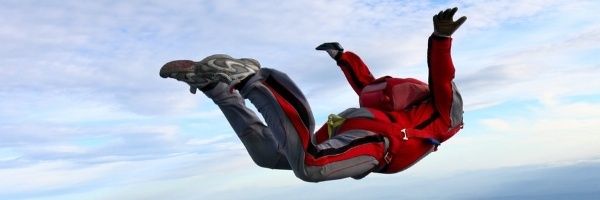
Stable flight depends on the relationship between the center of gravity and the aerodynamic forces acting on the body. The center of gravity is the point around which body mass is balanced. The center of pressure is the approximate point where the net aerodynamic force acts. In a good belly-flying arch, the hips are slightly lower into the wind than the chest and shoulders, while the arms and legs are spread symmetrically. This arrangement helps place the body”s mass beneath the main lifting and pressure-producing surfaces. When the body begins to tip, the airflow changes across those surfaces and tends to create a restoring moment that brings the position back toward equilibrium.
A useful comparison is a shuttlecock. A badminton shuttlecock naturally turns so its heavier end leads and its broad feathered end trails. A skydiver is not mechanically identical to a shuttlecock, and the human body is far more adjustable, but the analogy illustrates passive stability. The shape and distribution of mass can encourage the body to return toward a predictable orientation without constant correction. In practical terms, a stable arch should give the air a clear, balanced shape to support.
- Mass distribution: Keep the hips engaged as the central reference point rather than allowing the head or knees to lead.
- Surface area: Present the chest, thighs, and arms evenly so the airflow is not overloaded on one side.
- Symmetry: Match the left and right sides of the body to reduce unwanted roll and spin.
- Small corrections: Use controlled arm, leg, or hip inputs instead of large movements that disturb the entire pressure pattern.
Why Pushing Hips Forward Trumps Back Muscle Strain
The word “arch” can mislead beginners into thinking the movement must come from aggressively bending the lower back. That approach often produces discomfort, fatigue, and excessive tension. The more useful action is hip extension: gently driving the hips forward and allowing the pelvis to become the lowest central point facing the relative wind. The abdominal muscles, glutes, and hip flexors coordinate this shape, while the spine remains long rather than compressed into a painful bow.
Think of the body as a linked aerodynamic structure. The pelvis establishes the main pitch angle, the chest remains open, and the legs extend back with the knees slightly bent according to the training position. The head is lifted enough to maintain awareness, but not thrown backward. The arms are placed where the instructor directs, commonly out to the sides with relaxed elbows. Every part contributes to the same pressure picture. If the shoulders are raised or the knees are sharply tucked, the airflow shifts and the body may pitch, turn, or become difficult to control.
| Active fighting | Passive aerodynamic support |
|---|---|
| Lower back is forced into an exaggerated bend | Hips move forward while the spine stays comfortable |
| Shoulders and hands become rigid | Arms remain relaxed and responsive |
| Large corrections are made after instability begins | Small inputs maintain the existing balance |
| Breathing becomes shallow or stops | Steady breathing helps preserve relaxed control |
| Muscles attempt to hold every joint in place | Body geometry and airflow share the workload |
The distinction matters especially during an AFF jump or early tunnel session. If the lower back is doing all the work, the position may look arched from the ground while feeling unstable to the flyer. Hip pressure, by contrast, changes the body”s relationship to the airflow at its center. Once the air is supporting the torso and legs, the flyer can make cleaner heading, level, and forward or backward movement inputs. The body is no longer trying to create stability from inside itself; it is cooperating with the air column.
The Danger of Muscle Tension and the Freefall Feedback Loop
Tension creates a difficult feedback loop. A beginner senses a small roll and stiffens to stop it. The stiffening changes the shape of the arms, shoulders, hips, or legs, which changes the pressure on the body. The new pressure creates another movement, and the flyer responds with an even larger correction. What began as a minor imbalance can become a series of oscillations, spins, or abrupt pitch changes. The problem is not a lack of effort. It is too much effort applied through too many connected body parts at once.
Relaxation does not mean becoming limp or losing structure. A stable skydiver still maintains an active position, but the effort is distributed efficiently. Relaxed shoulders allow the arms to act as sensitive control surfaces. A soft jaw and steady breathing reduce the tendency to lock the chest and neck. When the exhale becomes available again, the body often settles immediately because the torso is no longer braced against an imagined impact.
Watch for early signs of over-controlling before they develop into a larger problem. An instructor or tunnel coach can identify these signs quickly, but you can also learn to recognize them during practice:
- Shoulders creeping toward the ears or elbows becoming rigid.
- Hands clenched, wrists bent sharply, or fingers held unnaturally tight.
- Breath being held while attempting a turn or heading correction.
- Lower-back fatigue caused by forcing the arch instead of moving the hips.
- Rapid, repeated arm movements that do not produce a clear result.
- Eyes fixed downward, reducing awareness of the horizon, coach, or jump team.
When these signs appear, the safest correction is usually a reset rather than another aggressive input. Return attention to breathing, soften the shoulders, reestablish symmetry, and let the instructor”s hand signals guide the next adjustment. In a training environment, follow the specific procedures taught by the dropzone. Stability is a skill built through repeatable body awareness, not through improvising force during a stressful moment.
Step-by-Step Calibration for a Rock-Solid Arch
Begin with one clear image: the belly button is the lowest point of the body in contact with the relative wind. This visualization helps prevent the common error of pushing the chest down while leaving the hips high. The objective is not to make the stomach physically touch the air first, but to organize the pelvis as the center of the arch. From there, allow the chest to remain open, the shoulders relaxed, and the legs extended evenly behind the hips.
Keep the chin lifted enough to see the instructor, other jumpers, or the horizon, while avoiding an exaggerated neck bend. The toes should point back in a symmetrical manner, and the knees should match rather than allowing one leg to trail or drop. Arms should be positioned according to the training brief, with the hands and elbows balanced from side to side. These details are simple, but they matter because asymmetry can introduce a turn before the flyer realizes that one side is producing more drag than the other.
- Breathe and soften: Exhale, lower the shoulders away from the ears, and release unnecessary tension in the hands, jaw, and neck.
- Drive the hips forward: Think of bringing the pelvis into the wind rather than bending harder through the lumbar spine.
- Restore symmetry: Check that both arms, knees, and feet are positioned evenly, then keep the head centered.
- Wait for the air: Hold the shape for a moment and allow the pressure to stabilize before making another correction.
This checklist is useful after an exit, following a turn, or whenever the body begins to feel unstable. It should not replace the signals, emergency procedures, or specific body-position instructions provided by a qualified AFF instructor. Training equipment, deployment procedures, altitude awareness, and canopy control remain essential parts of every skydive. The arch is one tool for controlled freefall, not a substitute for the complete training system.
Trust the Wind and Let Aerodynamics Do the Work
Stable freefall emerges from the interaction of relaxation, geometry, and fluid dynamics. Relaxation keeps small inputs from becoming exaggerated. Geometry places the hips, torso, limbs, and center of gravity in a useful relationship. Fluid dynamics supplies the pressure and restoring forces that make the position self-correcting when it is balanced. None of these elements requires you to overpower terminal velocity. The body becomes stable when it gives the airflow a consistent shape to support.
On the next jump, replace the thought “fight the wind” with a simpler sequence: breathe, hips forward, shoulders relaxed, body symmetrical, eyes up. If instability appears, avoid the instinct to add more force. Reset the arch, wait for the pressure to return, and then make only the correction that the situation requires. That mindset shift turns freefall from a contest against the air into a controlled partnership with it, giving you a calmer, clearer, and more dependable platform for every skill that follows.